Showing posts with label Islam. Show all posts

Friday, April 1, 2011

An Evening of Malhun at Jnan Palace

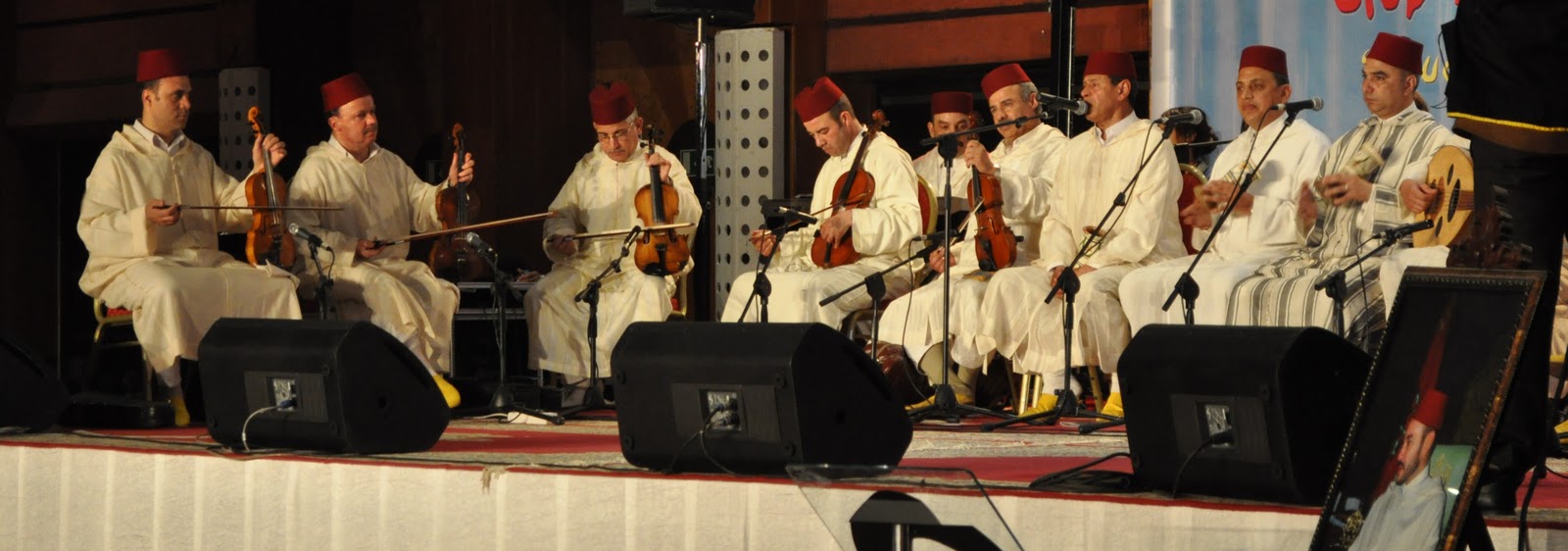
Abd al-Lawi of Meknès (far left), wrapping up last night's event with a good dose classical Moroccan wit
Last night I had the honor of attending the latest event put together by the Club Khamis Tourat, a Fessi organization that works to preserve traditional music and arts in throughout the city. The concert was the most recent of the monthly events at the Jnan Palace Fès Hotêl, and this edition featured five malhun singers from the city and nearby regions.

As soon as I walked into the wide hotel lobby, I recognized a number of musicians from the official radio station, people I had only met the day before. In good Moroccan custom, they approached me as an old friend, with wide, brightly lit smiles, excited that I was able to attend the show. I sat and spoke at length with some of the violinists, oud players, and singers who filled the stage, dressed in the clean lines of traditional jallabas and deep red fesses. Also in good Moroccan custom, the music failed to get underway until at least an hour after the scheduled time. (Similarly, the concert ended after 11:00, when the 7:00-9:00 written on the ticket was fading into distant memory.) Members of the group introduced me to visiting artists, explaining the not-so-subtle shifts forced upon them for the sake of their guests. Abd an-Nabi, for example, an upright bass player from the previous morning at the studio, opted to play cello, allowing an esteemed colleague from Meknès to step in on his preferred instrument.

Mohammed Sousi and Abd al-Ali Talibi, comfortably chatting as the 'ud players prepare for the performance
The event begins with a prayer, the musicians waiting patiently on stage. Not much later, a group of singers arrives, women who are learning the art of the malhun from Mohammed Sousi, one of the featured performers. As they ascend and take their places behind the musicians, you notice their caftans (elegant dresses), hair and makeup. Their dress emphasizes the importance of events like these - they would make any bride jealous.

After a series of introductions and blessings, the music bursts from the speakers. Immediately cameras pop up from the crowd as seated spectators race to capture the moment with point-and-shoot videos or makeshift iPhone photography. The hum of conversation continues under the strength of the sound reinforcement.

Abdellah Chakroun (center, facing away), the honored guest, receives one of his many congratulations and thanks during the intermission
Malhun is a genre of Moroccan music that straddles the divide between sacred and secular, just as it seamlessly moves from popular to art music, residing in a space between these (sometimes less than useful) labels. Songs are actually poems (qasdia, pl. qasa'id) with a refrain (harba) divided into long sections and sung by the munshid. Last night's event featured five munshids, some of the most prominent in this part of the country. The poetry is in Moroccan Arabic, not the classical Arabic or Egyptian that you hear in most forms of "imported" music. Subjects range from the religious (even borrowing from sacred qasa'id), to the comedic. The munshid alternates his long verses with the harba, sung by the full group, including musicians. Instrumental solos, based loosely on the main melodic content of the song, punctuate each 20-minute performance. Like much Arabic music, all the musicians on stage ebb and flow around one melodic idea, ornamenting it freely, creating a dense, yet somehow very simple, texture of overlaid sounds. (For an example of malhun recorded just the other day, see my last post and the story that goes along with it.)

Hiya bu-Khris takes the mic and commands the orchestra through her qasida
The ensemble was quite large, filling the stage with the stark white/red of the traditional outfits. Just under 30 musicians, including singers, percussionists (darbouka, riqq, and the dreaded electronic drum pad), 'uds, violins, and cellos were joined by the more traditional ginbri, an instrument often seen in Amazigh music, different Moroccan Sufi traditions, and elsewhere. The strings held a low pitch, giving a footing to a young virtuoso violinist as he opened the second song with a taqsim, an improvisation exploring the melodic mode, the scale, introducing it to the singers and the crowd. He, like all the fiddle players, held the instrument upright, setting it on his knee. The bow is held underhand, in a grip akin to the "German bow" used by many classical bass players. While he draws the bow across the string, he actually twists the instrument in order to change which string he's playing on, a technique specific to malhun and other Andalusian violinists, one probably based on the rabab, an older spike fiddle seen across the Middle East.

Mohammed al-Nahbiwi (third from the right), featured in "Dir ma'ya l-hsan"
As Abd al-Ali Talibi wipes his forehead, removing his fes to clean the sweat from his marathon that opened the concert, Mohammed Sousi dives into the second qasida, "Zaynib." The meter shifts seamlessly between 4 and 5 beats per cycle. The 5-count has an off kilter feel to it, yet it's slow enough that you don't quite notice until you try and pay attention. Multiple percussionists and singers beat interlocking simple rhythms on small clay drums until the sum of the parts is a tightly-knit dense layer, over which the singing and string players set their simultaneous melodic ornamentations. After the qasida runs its course, the ensemble picks up the tempo, the crowd beings clapping in line with the different percussive hockets, and the energy tugs the song to a close. This is the standard ending for the malhun, and sounds familiar - it's a practice that's repeated throughout much of Morocco's spiritual music.

The evening was dedicated to researcher and author al-Ustad Abdellah Chakroun. He was the center of attention during a prolonged presentation between the second and third performers. Speeches, a short film, and awards found themselves directed toward one of the men to preserve and present the malhun, other Andalusian music, and, if I understood correctly, intellectual property law in Africa.

Those who made it to the end were treated to high energy finales, enough to get people on their feet
The second half of the concert featured two women, Hiya bu-Khris and Fatima Zahra al-Wazani, a welcome programming choice in the masculine world of Moroccan professional musicians. However, the difference between the two could not be more striking as Hiya's poise and power carried the ensemble in new directions, a diversion away from the opening (male) voices. Yet Fatima Zahra lacked the courage necessary to lead, and in the delicacy of her voice one could hear the struggle in performing malhun. Those who have listened to flamenco may recognize the raw tonal quality desired, something halfway between singing and shouting. The inexperienced singer, unable to maintain the stamina necessary for pushing out an entire qasida, falls prey to the difficulties of rising above such a large ensemble. Fatigue is audible, inconsistencies arise, pitch falls, the munshid loses control. It is an important reminder of the physical and mental strain inherent in performance.

Mohammed Abd al-Lawi of Meknès closed the performances with a qasida, "Hasan al-Kharbiti," dripping with wit. As it begins: "Have you heard the poem about Hasan? The day of his wedding was coming..." Those to stuck it out to the end were rewarded with this story, poor Hasan's trials in preparing for his wedding night.

Mohammed Sousi (center, grey jallaba) with the singers and event organizers from Club Khamis Tourat

Monday, February 28, 2011

Trek to Meknès

Our grand taxi, and the kind man who supplied our tissue needs.
You may remember my summary of expectations, some things I jotted quickly before we went off to Meknès for the moussem. Well, we made the trip and went on our way, but (of course) I forgot to charge my battery beforehand. It's rare for me to be wandering around with the nice one, so I went a bit photo-crazy and ran it out before the actual moussem started. I'll give you what I got.

As for the celebration, we got to Meknès' central square, the Hdima, to find people milling around as if it were any old normal day. Disappointment set in. Then, in the crowd, we saw some flags rise above! Knowing Morocco, we assumed that things would take a few hours to get going, so we took our time and visited a café, strolled through the food market, and Annie even got herself a towel/hat for coming home from the public bath.

Then the crowd got itself going. For about 45 minutes we watched some kids and old men team up to try and lift a giant rug with a 10-foot business card pasted to the front (think of the signs that you sometimes see leading a parade, announcing just which fire department you're watching walk by). The wood-braced carpet followed the six flags and a fella carrying a two-foot wide incense burner. Then you had the 'Assawis who formed a circle and performed their "hadra" ceremony (lots of jumping and swinging, looked pretty fun), and 6 ghaita players sitting atop horses. The ghaita is a double reed, much like an oboe, but far, far, far louder, made for playing in large outdoor spaces such as this. The players maintained winding melodies that cut through the noise of the crowds and reached us as we attempted to snake toward and away from the activity. We retreated to a café sitting along one of the city walls so we could watch from a better viewpoint as the group slowly progressed under us and around a busy corner. Shops and salesmen pulled in their goods, waited for the spectacle to pass, and reset themselves as before as a more typical stroll overcame the streets.

We saw a good friend of mine leading the group, and I need to get a hold of him now that things are settling back down. I have questions, he has answers. PS: no one tried to eat our clothes (we were worried, since a few from our group wore black!).

It feels good to get out of the city every once in a while.

Annie and Carol enjoying the ride out.

The best part of this moderately ridiculous museum was the sunshine.

This was the last photo I took before the battery died. But isn't it a beautiful coffee?

Thursday, February 17, 2011

The 'Aissawis of Meknès

Today we're heading to Meknès, a nearby city, for the moussem. Yesterday was the Prophet's birthday, a holiday that sets off a long series of celebrations across the country. The first, and in some ways, most well known, is only a few hours away by taxi. It began yesterday and will continue through tomorrow, so we'll be just in time to catch the height of the celebrations.

Meknès is home to the major shrine to Sheikh al-Kamil, the "patron saint" (if you will) of the 'Aissawa brotherhood. The 'Aissawis are one particular sect of Sufis who I have had the pleasure of working with in the past. Their music is incredibly popular, and the presence of a large group (15 or so  members) is a staple for weddings, naming day celebrations, and other life celebrations. They also perform layla rituals, not completely unlike the Gnawa (the sub-Saharan group that made of the bulk of my past research). They foster relationships with some of the same historical figures, saints, and spirits. Further, the ceremonies heal inflicted individuals (spiritually and physically) and provide baraka (blessing) to the families that are present.

During this moussem, I have been told a bit about what to expect, but of course, when you're dealing with religious topics, foreign languages, and multiple perspectives, you really can't get a grasp on what's coming. It will all be a bit of a surprise.

'Aissawa groups, led by flagbearers, will process from the central square to the shrine of Sheikh al-Kamil. They will be performing segments of the ritual, songs that are known to the crowds, and potentially a few things that invite adepts to fna, literally extinction (of the self into Allah). The groups are large, percussion heavy (mostly hand drums of different sorts), and include a few wind players. They usually have two or three 6-foot long trumpets that play complex and coordinated rhythms between them, creating an unexpectedly tight stereo experience. The ghaita, a relative of the oboe, plays long, winding, ornamented melodies alongside the chanting. Each group, I am told, will have a cow. Upon entering the shrine, there is a sacrifice, and celebration ensues once again.

We were warned that if we wear red or black, people who are trancing might try to eat our clothes. Not sure yet what to make of it, but I'm wearing brown.

After this, the mawsim (moussems) continue in two other cities, taking me on a trek across Morocco as I jump full steam into research. Classes are pretty much finished, and now the real work clicks into gear.

Peace

Monday, December 6, 2010

Happy New Year!

So I decided that this deserves a blog post.

Annie and I are sitting in our living room at 8:42pm waiting to find out if we have classes tomorrow. If so, we have to get up to get to school by 8am, and I probably won't have my homework finished. But if we don't, we sit and relax for a day.

See, tomorrow is "ras al-'am" or "ras as-sina." The head of the year, or the Islamic New Year. We should be singing "Auld Lang Syne," but instead I need to find out if I have to write a dialogue in Moroccan Arabic about going to the doctor for my early morning classes. I feel so not-festive. Earlier I told someone that we might come visit tomorrow since it's the New Year and we may not have classes. He thought I was crazy, and told me "It's only December 6th." "Hijra!" "Oh yeah, that's right." With a potential day off of work, you'd think people would be more interested!

So the change of the Islamic month depends on the moon (it's a lunar calendar). You can't tell when a new month begins until you have a sighting late at night. If you have a TV, you find out quickly, but if you don't (like us), you have to go around asking people whether or not it's the new year.

Our Advent wreath, burning bright
Keeping with the holiday season, we started an Advent wreath. The only candles that we could find on short notice, however, were from near the Moulay Idriss mosque. Shopkeepers line the neighboring streets selling these candles (and much bigger ones), all varieties of incense, prayer beads, rosewater, scented oils, and items from the Hajj (pilgrimage to Mecca). All of these things are for specific uses during ceremonies and rituals, so we figured that we were alright using them for a wreath. Eh? You make do. Purple candles aren't very popular for some reason or another.

Turkey dinner!
Thanksgiving was a treat as well! Thursday afternoon we found ourselves turkey paninis. With great french fries. Yes, nothing says American Thanksgiving like a turkey panini and french fries. The next evening, though, we were invited to a Thanksgiving party that included a roasted turkey (brought live from Marrakech) and PB&J sandwiches.

PS: Just got a call from a friend, it's New Years! Happy New Year everyone!

Wednesday, November 17, 2010

Eid Mubarak Said!

He has no idea... Or maybe he does.
Today was day one of Eid al-Kabir, the celebration of Abraham's willingness to sacrifice his son. Each family finds themselves a nice "kabsh" (ram) for the household, and this week has been full of people asking us if we have yet to get our own. "Mazal," not yet... I never knew that rams were so loud, and I never got so much enjoyment from watching people attempt to convince these large animals to walk down the street. But all that is over now - this morning the unbelievable ram population here in Fez diminished rapidly.

The man with the plan, and the deed is done.
Preparations throughout the city were extensive. Men selling grains (for the short-term pets) and offering to sharpen knives (also for the short-term pets) filled the streets. There is an entire mini-economy around the Eid, especially considering that the animals go for a small fortune, $200-400 each! No, we did not get our own, although they are pretty cute.

Annie with Hiba, the youngest daughter.
A family invited us to their celebrations, they have been kind and welcoming to us for a few years now, smothering us with their generosity. We woke them up this morning (whoops), after the hour-long call to prayer. We didn't want to miss the sacrifice, of course! Following a quick breakfast, the man arrived who was to do the deed... The mini-economy also includes a number of wandering butchers, going from house to house and taking care of business. This fella, however, was a friend of the family, much more trustworthy than a rushing butcher! You can't mess around with your ram.

Cleaning up the blood, in heels.
The entire family went upstairs, and of course I brought the camera. I'll spare the gory details (but not all of the gory pictures), and just say that it took a while to get everything taken care of, and this family, like the rest of Fez, is going to be eating meat for a long time. The highlight: the mother decided that it'd be funny to scare Annie with the ram's head.

A picture is worth a thousand words. Mama Boujma goes after Annie...
Eid Day 1 involves sacrificing the animal (you only get two cuts, so you better make them good), skinning it, and getting all the organs out. The skin, now inside out, gets salted and saved for later, when it's given to the leather workers and made into decoration, a prayer rug, or sold. Kids  in the street spend the day roasting heads for the neighbors, which become breakfast for the next morning. (If we visit anyone tomorrow, we're going to be sure to be late...) The liver and heart turn into brochettes (kabobs), which, for our lunch today, were cooked over an open fire in the living room. Unexpected. Then, nap time. At this point, we found our way out and came home. I believe that the stomach turns into dinner (slow cooked), and the meat becomes a consistent meal for days to come.

One down (on the right, hanging), one to go.
The man of the house.
My secret hope for this whole process? I want to get a pair of ribs, so I can play the "bones" in the bluegrass band when I get back to the states. Tomorrow? We're heading back - Annie's getting henna (I'll post pictures) and we're going to partake in the more "meaty" meal, now that the liver's gone.

Eid mabarak said!

Liver brochettes for lunch. They were quite good! And followed with liver-stuffed heart.

Tuesday, November 9, 2010

Al-Ashiya al-Gnawiya

Hamid, Abd ar-Rzaq, and Annie having some pre-ceremony tea.
One week in, and I think my dissertation research is done.

Yesterday we were invited to an Ashiya Gnawiya, a Gnawa afternoon. Now, I'd been to a Gnawa layla before. In fact, the layla (night) ceremony made up a few chapters of my masters thesis. In the layla, people (mostly women) who are possessed by a mluk (spirit) go into trance during the segment of music dedicated to that particular spirit. Some of the mluk are from Islamic history (Moses, Abraham), while some are sub-Saharan (Aisha, Mimun). The maskun (possessed) are covered with cloths matching the color of the spirit and feed on the jawi (incense) to strengthen the possession.

This ashiya (afternoon) was not supposed to have any of this. But it did.

The event was held for a woman who was having trouble breathing. The belief is that these types of health issues can come from an unhappy mluk, or a new one. In order to appease the spirit, the maskun must hold a ceremony. The ashiya, however, is cheaper than a layla, and shorter. After two or three hours (and no possession) we expected the event to end, but then the woman went into a deep trance, screaming, rolling on the ground. People came from around the room to help her, bring her to the incense, and push her into the next stage. Then the layla portion began as the musicians went into the series of songs that bring on each mluk.

If anyone is interested in the specifics of the theology and traditions, let me know. This is hardly the venue for such a conversation.

The big news, though... unlike in the past, the musicians allowed (even requested) me to record the entire thing. In the past, I've taken pictures and recorded the opening portion, but once the trances begin, it's all off limits for obvious reasons. This time, however, they kept asking me for my recorder and putting it prime position between them. If I had to, I could transcribe this event, get the lyrics, and write a paper. Pardon my excitement. Upon later listening, however, it's shocking just how intense and frightening the entire experience is.

The musicians. Abd ar-Rzaq was my teacher during the last few trips, in red. The man to his right is restringing his hajhuj.