Showing posts with label Music. Show all posts
Showing posts with label Music. Show all posts
Monday, June 13, 2011


Saturday, June 11, 2011

Friday, June 10, 2011
Assawi Preview
Some info on tonight's Aissawa gig at Boujloud. (Unlike the other posts, the photo on the page is not mine and will hopefully be updated soon.)

Thursday, June 9, 2011
Youssou Ndour, Explained

The View From Fez used a few of my comments on their article about Fes Café's concert last night.
They also let me add some meat to their Youssou Ndour article, explaining a bit of the unexpected ending that highlighted the performance.
Wednesday, June 8, 2011
Catching the Rappers @ the Fez Festival

Tuesday, June 7, 2011

Malhun Music at the Fez Sacred Music Festival

A short interview I did with Mohammed Sousi about his upcoming Malhun performance on Saturday night.
Monday, June 6, 2011
Photos from the Festival of Sacred Music
For the duration of the festival, I'm going to try to upload some of my favorite photos each day or so. Since I'm fairly lazy, and just putting up a long series of posts here of only large pictures would drag down the entire page, I'm going to go ahead and use Facebook's photo uploader. If you don't have an account or are not my friend (why would that be?), you can access the constantly expanding album here. Check back often!
Nass al-Ghiwane and Darqawiyya - great sounds from different worlds

Nass al-Ghiwane rocked Boujloud last night. Here is the article. PS: The titles of these things are not mine...
Sunday, June 5, 2011
Saida Fikri @ Boujloud and Harakiyya Brotherhood at Dar Tazi

As the Fez Festival of Sacred Music gets underway, I'm going to be writing for a local blog (that gets many more hits than mine). Check out the first article here, about Saida Fikri's performance at Bab Boujloud and the beginning of the Sufi Nights afterward.
Saturday, June 4, 2011
Leyla et Majnun: and the Festival Begins
 |
| Starting with a bang. (Sorry, I couldn't help it.) |
The piece was a setting of a classical Arabic story in which Qays ibn al-Mulawwah falls madly in for Layla, whom he met while a young man. Yet, his love overcame him, driving him to the point of madness, causing her father to forbid their marriage. He becomes known instead as Majnun, a term reserved in Arabic for the insane or possessed.
The performance opened with a reading of the story, featuring the sound of the Arabic poetry. Once the oratorio was fully underway, however, the array of solo vocalists performed in Arabic, Farsi, Urdi, Turkish, Mongolian, and French. As the movements continued, it became obvious that this was a composition about the sound and flexibility of the human voice. For a quick example, this (http://www.youtube.com/watch?v=DY1pcEtHI_w) was one of the included techniques, something few of the audience members likely knew was possible!
 |
| Waiting for Royalty |
To be completely honest, however, I must say that it was Bruno Le Levreur who stood out among the impressive cast of performers. His contra-tenor (singing in the high female soprano range) was controlled, lyric, and graceful. When his moments approached, the bed of music around him lowered into simple, classical accompaniments. The purity of his tone emphasized the balanced melodies and heightened the aura of elegance that spread across Bab al-Makina.
The composition itself straddled that difficult line, bringing Arabic musical ideas and stylings into Western classical space. Amar negotiated the space between the melodically-driven "Eastern" elements and the harmonically-centered "Western" by often privileging the modes, melodies, and ornaments that are so common here in Morocco and elsewhere in the Arab world. Phrases were long, exercising the listeners' patience, rewarding them with beautifully rendered cadences and closures. Non-Western scales pervaded the work, but they were often underpinned by similarly expansive harmonies from the strings or pulsing rhythms from the deep percussion.
It is easy to become used to hearing vocal acrobatics in the form of high, fast, or powerful notes and sounds, but the featured performers tonight challenged, and ultimately extended, expectations. By including vocalists from unique traditions across North Africa, the Middle East, and Asia, the oratorio focused on exploring the breath and sound of the human body. In doing so, it attempted to make concrete the connection between spirit and body, of the sacred of religious experience and the sacred of artistic expression.
The composition itself straddled that difficult line, bringing Arabic musical ideas and stylings into Western classical space. Amar negotiated the space between the melodically-driven "Eastern" elements and the harmonically-centered "Western" by often privileging the modes, melodies, and ornaments that are so common here in Morocco and elsewhere in the Arab world. Phrases were long, exercising the listeners' patience, rewarding them with beautifully rendered cadences and closures. Non-Western scales pervaded the work, but they were often underpinned by similarly expansive harmonies from the strings or pulsing rhythms from the deep percussion.
It is easy to become used to hearing vocal acrobatics in the form of high, fast, or powerful notes and sounds, but the featured performers tonight challenged, and ultimately extended, expectations. By including vocalists from unique traditions across North Africa, the Middle East, and Asia, the oratorio focused on exploring the breath and sound of the human body. In doing so, it attempted to make concrete the connection between spirit and body, of the sacred of religious experience and the sacred of artistic expression.

Sunday, May 15, 2011
From Virginia to Fez: Maghrebi Bluegrass "Fusion"

This past Tuesday, we all went to a bluegrass concert. Yes, that's right. Bluegrass in Fez. The US Embassy in Rabat and a variety of local sponsors brought a pair of Virginians to Morocco for "une série de concerts de fusion maroco-américaine." They were joined throughout the entire tour by Abdelilah el-Miry, a Moroccan musical celebrity (thanks, in part, to his visible Simon Cowell-like presence on an American Idol recreation of sorts). Local musicians filled out the "band" in each of the three cities: in Fez it was augmented with four members of an Andalusian troupe.
As I sat waiting (the performance finally started 45 minutes late!), I was unnerved, as I usually am when concerts advertise "fusion" so readily. The American musicians were flying through a whirlwind tour of Casablanca, Tangier, Fez, and Chefchaouen. How were they to "fuse" with anyone other than Miry?
The crowd consisted of a mix of American and European expats and Moroccans. While it was not as full as other events I'd seen in the building, it was great to watch Moroccans getting down with some bluegrass. (Sadly, most of the foreigners, were less enthused about the Moroccan music... I'll get into that later.)
Just before our down-home Virginians came out, there was an introduction in Arabic and English that confirmed my suspicions, and heightened my anxiety: "echos" of the music won't sound "that foreign," and these two traditions may catch you buy surprise, even sounding like something that "you might hear on the radio." I've heard this discourse before, including at the slew of festivals that inundate Morocco every summer. The truth is, though, that sometimes these projects fail (confused musicians trying to make the best out of an awkward and hastily assembled musical opportunity), sometimes they soar (real cohesion into something you've never heard before, and may not hear again). Oddly enough, they rarely fall in between these two extremes. Our "Bluegrass Maghribi" event had a bit of both.
As James Leva and Danny Knicely entered the stage, we finally got to hear some music. They picked up their fiddle and guitar, diving right into a series of old fiddle tunes. (A quick rant, that I'm sure few of you will care about, but I need to get off my chest nonetheless: very little of what they played was actually bluegrass. These old tunes and harmonies were just as much Appalachian old-timey music, not surprising since the two musicians hail from closer to the east coast than Bill Monroe's old Kentucky.) Their playing was refreshing, it felt like home.

When Abdelilah el-Miry walked out with his suissen (a small stringed instrument used in a vast array of Moroccan genres), they took their first stab at "fusion." By taking advantage of the bluesy licks inherent in some Amazight musics of the Atlas mountains, the group passed phrases back and forth, almost playing a game of Simon Says. They met the goal - establishing a point of commonality, of similarity, of familiarity - but the high points of the song were those moments when one of the performers grew restless, took a solo, and momentarily extended that point of departure into an actual platform from which to depart. This, after all, is the point of fusion. But it was just the first kernel, an experiment, one that was probably more appropriate for the rehearsal space than the stage. It was still voices speaking at each other, not yet a conversation. The sum of the parts was still greater than the whole.
When the band grew further, with the addition of four members of a Fessi Andalusian music troupe, the concert changed course. The focus shifted to playing Andalusian songs, from the dominant classical music tradition of northern Morocco. The performers were phenomenal. This, however, was where these types of events often fall short. Instead of "fusion" as advertised, visiting musicians are asked to play other genres of music, to be part of a group and play things that, well, are foreign to them. With just a few days notice, and a packed schedule of travel and performance, how are they to effectively participate in genres that carry so much depth? How are they to do anything other than hope the remember the notes to a song that they admit to having learned that morning? They can't help but to struggle alongside their expert counterparts, hoping for some leadership and just a sliver of a chance to add something from their own musicality to the final product. Having been in this situation myself, I can't help but feel the frustration that comes with hoping to cling to the fluency of your neighbor.
On this account, Miry was really the star of the show. An American fiddle song hobbyist here in Morocco, he demonstrated an adeptness for both the Moroccan and the old-timey. He went beyond playing notes that fit the scale, harmonies that worked with the melodies. His interpretation, his musical ideas, and his delivery reached "fluency" (for lack of a better word).
While the event oscillated between the Moroccan and American, with the encore the group peaked. James Leva put down his fiddle and reached instead for the clawhammer banjo (a fundamental ingredient to the old-timey sound) and the effect was jarring. Performing a sung melody that is ubiquitous throughout Morocco, all the musicians were equally comfortable, excited, and ready to contribute. The major key and implied harmony gave space for James and Danny to add harmonies and phrases above the rest of the texture, and the banjo/'ud combination added the missing texture. They achieved their goal, they found that elusive familiarity and gave a new musical ideas to those who sat through the event. (When they heard that the final song would be Moroccan, a number of the expats simply got up and left, presumably uninterested in hearing more Andalusian music.) The real shame, though, is that just two days later, James, Danny, and el-Miry had to go to Casablanca and begin their search anew with a different cast of musicians and music.
Friday, April 1, 2011
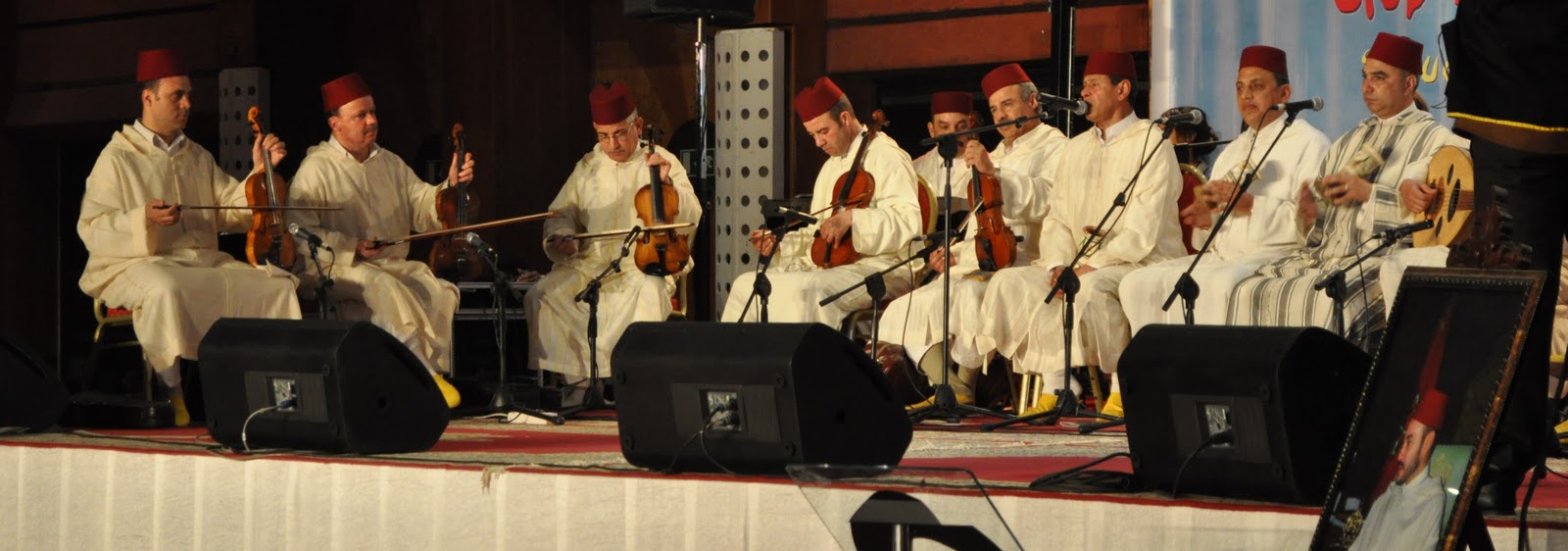
An Evening of Malhun at Jnan Palace
 |
| Abd al-Lawi of Meknès (far left), wrapping up last night's event with a good dose classical Moroccan wit |
As soon as I walked into the wide hotel lobby, I recognized a number of musicians from the official radio station, people I had only met the day before. In good Moroccan custom, they approached me as an old friend, with wide, brightly lit smiles, excited that I was able to attend the show. I sat and spoke at length with some of the violinists, oud players, and singers who filled the stage, dressed in the clean lines of traditional jallabas and deep red fesses. Also in good Moroccan custom, the music failed to get underway until at least an hour after the scheduled time. (Similarly, the concert ended after 11:00, when the 7:00-9:00 written on the ticket was fading into distant memory.) Members of the group introduced me to visiting artists, explaining the not-so-subtle shifts forced upon them for the sake of their guests. Abd an-Nabi, for example, an upright bass player from the previous morning at the studio, opted to play cello, allowing an esteemed colleague from Meknès to step in on his preferred instrument.
 |
| Mohammed Sousi and Abd al-Ali Talibi, comfortably chatting as the 'ud players prepare for the performance |
After a series of introductions and blessings, the music bursts from the speakers. Immediately cameras pop up from the crowd as seated spectators race to capture the moment with point-and-shoot videos or makeshift iPhone photography. The hum of conversation continues under the strength of the sound reinforcement.
 |
| Abdellah Chakroun (center, facing away), the honored guest, receives one of his many congratulations and thanks during the intermission |
 |
| Hiya bu-Khris takes the mic and commands the orchestra through her qasida |
 |
| Mohammed al-Nahbiwi (third from the right), featured in "Dir ma'ya l-hsan" |
The evening was dedicated to researcher and author al-Ustad Abdellah Chakroun. He was the center of attention during a prolonged presentation between the second and third performers. Speeches, a short film, and awards found themselves directed toward one of the men to preserve and present the malhun, other Andalusian music, and, if I understood correctly, intellectual property law in Africa.
 |
| Those who made it to the end were treated to high energy finales, enough to get people on their feet |
Mohammed Abd al-Lawi of Meknès closed the performances with a qasida, "Hasan al-Kharbiti," dripping with wit. As it begins: "Have you heard the poem about Hasan? The day of his wedding was coming..." Those to stuck it out to the end were rewarded with this story, poor Hasan's trials in preparing for his wedding night.
 |
| Mohammed Sousi (center, grey jallaba) with the singers and event organizers from Club Khamis Tourat |
Thursday, March 31, 2011
The afternoon's work extends into the evening
So it didn't take quite as long as I expected to get around to uploading the recording from this afternoon in the studio with Mohammed Essousi. Here's a link, although the parade of photos were at his request...
Wednesday, March 30, 2011
Poetry to my ears

Earlier this week, I was invited to a wedding, an American man (whom I had never met) marrying a Fessi woman (whom I had also never met). I declined the offer from a mutual friend and well-known local Hamadsha musician. Yet I did go with him as he waited for it to start. We sat at a café and he called one of his friends.
 |
| Mohammed Sousi (right) and Abd an-Nabi, the first upright bass player I've spoken with in Fez. He let me touch it. I miss bass. |
The singer invited me to his house a few days later, asking me to bring my fiddle along. After a long, pleasant walk through my old neighborhood (where I lived in 2006), I found him at an imposing, shiny, oversized café. He grabbed my arm, pulled me along the road reminding me to remember the route, so I can find it again without his help next time. I had to prove my memory to him when we arrived by drawing up a quick map in my notebook. I had passed my first test.
 |
| Even in the studio, you're surrounded by the ubiquitous Moroccan tea. |
 |
| Two of the four violinists (kamanji) warm up. Players set the instrument on their knees and play it upright. Instead of changing the angle of the bow to hit different strings, they simply twist the fiddle a bit with a flick of the wrist to move up and down the range. |
The building had the sense of being just a nudge or two above not-quite-official. Wood paneled walls, oddly arranged rooms, and a general no-longer-white coloration consumed the place. Suddenly, though, the group kicked into gear and they were off. Everyone knew the song, no discussion of form or key, and the communication between musicians added to the lively beat. I made a recording myself, using my pocket-sized gadget, which I will hopefully post someplace useful online in the coming days. It's worth the listen.
 |
| Mohammed Sousi at his home showing of a recent gift. Someone had written a favorite poem on an animal skin and framed it. |
The afternoon concluded with a return to the recording studio where Mohammed and some of the girls from his ensemble were doing a series of interviews for a local radio problem. I sat with them, understanding the words but not the context, and before I knew it, I was being asked questions about myself, working in Morocco. Yet, instead of discussing music or my work, I was thrown off-guard with a series of interrogations on my favorite Moroccan food. In the moment, of course, I couldn't think of lamb with prunes, and so I just fumbled like a fool, trying to reconcile the situation with my complete surprise. But hey, now I'll be on the radio. Luckily, it'll be at 9am on a Saturday, when hopefully no one is paying attention.
Tomorrow's another day, we'll see where we end up, yes?
 |
| As an unrelated aside, headlamps are in. Seems that were the only folks that we know who don't have them. We're stuck living with these two.. Matt and Mitch are our roommates in the new house. Say hi. |
Monday, February 28, 2011
Trek to Meknès
 |
| Our grand taxi, and the kind man who supplied our tissue needs. |
As for the celebration, we got to Meknès' central square, the Hdima, to find people milling around as if it were any old normal day. Disappointment set in. Then, in the crowd, we saw some flags rise above! Knowing Morocco, we assumed that things would take a few hours to get going, so we took our time and visited a café, strolled through the food market, and Annie even got herself a towel/hat for coming home from the public bath.
Then the crowd got itself going. For about 45 minutes we watched some kids and old men team up to try and lift a giant rug with a 10-foot business card pasted to the front (think of the signs that you sometimes see leading a parade, announcing just which fire department you're watching walk by). The wood-braced carpet followed the six flags and a fella carrying a two-foot wide incense burner. Then you had the 'Assawis who formed a circle and performed their "hadra" ceremony (lots of jumping and swinging, looked pretty fun), and 6 ghaita players sitting atop horses. The ghaita is a double reed, much like an oboe, but far, far, far louder, made for playing in large outdoor spaces such as this. The players maintained winding melodies that cut through the noise of the crowds and reached us as we attempted to snake toward and away from the activity. We retreated to a café sitting along one of the city walls so we could watch from a better viewpoint as the group slowly progressed under us and around a busy corner. Shops and salesmen pulled in their goods, waited for the spectacle to pass, and reset themselves as before as a more typical stroll overcame the streets.
We saw a good friend of mine leading the group, and I need to get a hold of him now that things are settling back down. I have questions, he has answers. PS: no one tried to eat our clothes (we were worried, since a few from our group wore black!).
 |
| It feels good to get out of the city every once in a while. |
 |
| Annie and Carol enjoying the ride out. |
 |
| The best part of this moderately ridiculous museum was the sunshine. |
 |
| This was the last photo I took before the battery died. But isn't it a beautiful coffee? |
Thursday, February 17, 2011
The 'Aissawis of Meknès
Today we're heading to Meknès, a nearby city, for the moussem. Yesterday was the Prophet's birthday, a holiday that sets off a long series of celebrations across the country. The first, and in some ways, most well known, is only a few hours away by taxi. It began yesterday and will continue through tomorrow, so we'll be just in time to catch the height of the celebrations.
Meknès is home to the major shrine to Sheikh al-Kamil, the "patron saint" (if you will) of the 'Aissawa brotherhood. The 'Aissawis are one particular sect of Sufis who I have had the pleasure of working with in the past. Their music is incredibly popular, and the presence of a large group (15 or so members) is a staple for weddings, naming day celebrations, and other life celebrations. They also perform layla rituals, not completely unlike the Gnawa (the sub-Saharan group that made of the bulk of my past research). They foster relationships with some of the same historical figures, saints, and spirits. Further, the ceremonies heal inflicted individuals (spiritually and physically) and provide baraka (blessing) to the families that are present.
During this moussem, I have been told a bit about what to expect, but of course, when you're dealing with religious topics, foreign languages, and multiple perspectives, you really can't get a grasp on what's coming. It will all be a bit of a surprise.
'Aissawa groups, led by flagbearers, will process from the central square to the shrine of Sheikh al-Kamil. They will be performing segments of the ritual, songs that are known to the crowds, and potentially a few things that invite adepts to fna, literally extinction (of the self into Allah). The groups are large, percussion heavy (mostly hand drums of different sorts), and include a few wind players. They usually have two or three 6-foot long trumpets that play complex and coordinated rhythms between them, creating an unexpectedly tight stereo experience. The ghaita, a relative of the oboe, plays long, winding, ornamented melodies alongside the chanting. Each group, I am told, will have a cow. Upon entering the shrine, there is a sacrifice, and celebration ensues once again.
We were warned that if we wear red or black, people who are trancing might try to eat our clothes. Not sure yet what to make of it, but I'm wearing brown.
After this, the mawsim (moussems) continue in two other cities, taking me on a trek across Morocco as I jump full steam into research. Classes are pretty much finished, and now the real work clicks into gear.
Peace
Meknès is home to the major shrine to Sheikh al-Kamil, the "patron saint" (if you will) of the 'Aissawa brotherhood. The 'Aissawis are one particular sect of Sufis who I have had the pleasure of working with in the past. Their music is incredibly popular, and the presence of a large group (15 or so members) is a staple for weddings, naming day celebrations, and other life celebrations. They also perform layla rituals, not completely unlike the Gnawa (the sub-Saharan group that made of the bulk of my past research). They foster relationships with some of the same historical figures, saints, and spirits. Further, the ceremonies heal inflicted individuals (spiritually and physically) and provide baraka (blessing) to the families that are present.
During this moussem, I have been told a bit about what to expect, but of course, when you're dealing with religious topics, foreign languages, and multiple perspectives, you really can't get a grasp on what's coming. It will all be a bit of a surprise.
'Aissawa groups, led by flagbearers, will process from the central square to the shrine of Sheikh al-Kamil. They will be performing segments of the ritual, songs that are known to the crowds, and potentially a few things that invite adepts to fna, literally extinction (of the self into Allah). The groups are large, percussion heavy (mostly hand drums of different sorts), and include a few wind players. They usually have two or three 6-foot long trumpets that play complex and coordinated rhythms between them, creating an unexpectedly tight stereo experience. The ghaita, a relative of the oboe, plays long, winding, ornamented melodies alongside the chanting. Each group, I am told, will have a cow. Upon entering the shrine, there is a sacrifice, and celebration ensues once again.
We were warned that if we wear red or black, people who are trancing might try to eat our clothes. Not sure yet what to make of it, but I'm wearing brown.
After this, the mawsim (moussems) continue in two other cities, taking me on a trek across Morocco as I jump full steam into research. Classes are pretty much finished, and now the real work clicks into gear.
Peace
Monday, August 30, 2010
Stumbling into Surprises, Last Night in Town
Last full night in Ghana. The plan is to head down to the coast, find someplace to grab a bite, and meet Annie at Bywel's, the same place we heard some high life music when we were here a few weeks back.
That's not at all how the night went down.
While walking through something of a beach town slum, I hear some drumming. Crossing a makeshift bridge, I see some dancing. Surprisingly enough, Accra's oceanside coast is not home to international hotel chains or posh pool bars. Instead, it's a 15 year old corrugated steel Hooverville that sits peacefully, waiting as the tide laps up, just feet away. Just beyond this interconnected maze of propped up housing stands the presidential palace, looking like a fort on a cliff from behind.
The music and dancing that I'm slowly stumbling into is part of a royal drumming school, and 30 or so people are digging into the sound as the sun goes down. I stand, noticed, but untouched, and start passing by the group's concrete stage. Rounding the circular building, I found the head drummers, who invited me in and introduced themselves and their resident white guy, Claas (Klaus).
 |
| Gettin' down in the back... |
I'm excitedly pulled into one of the corrugated houses, and I find myself standing in front of a full bar. The English Premier League is playing on a TV set. Everything short of darts. Claas orders a Star beer, asks if I'm interested. No, haven't eaten dinner yet! I change my mind when I see the tasty beverage in front of me. He also gets a "Striker" - about 2 shots of gin in a plastic, sealed pouch. The 'tender has to find the scissors to clip off a corner and fill a glass, along with some lime juice. "Claas, that's my summer drink of choice right there, a gimlet!" He's surprised and gets excited. Later in the night, I have one of my own and we toast my lost wanderings while sitting in a shack/bar looking over the coast.
 |
| Claas and Senegal, chillin' hard. Yes, that is the ocean in the background on the right. |
 |
| Lessons from royalty. |
Delta, in trying to keep us "safe," took us through 18 checkpoints and consumed the 3 hours that we spent in the airport (good thing we were early!). They let us on, found a place for the kora, and plopped us in our spots. Bam, going home. Two movies, a book, and some TV later, we were in Atlanta.
I finished "On the Road" just as we came home. Felt right.
 |
| The drumming and dance school. |
Sunday, August 22, 2010
Dakar. Check.
 |
| You're either on the bus or you're off the bus. |
We hit the town hard yesterday. We dedicated ourselves to food. Breakfast on the terrace (it was hot), good coffee, great breeze, perfect. The hunt was already on for lunch. After checking in on some clubs in the trendy Point E district across from the university, we found ourselves at an Ethiopian restaurant. Finally we find some good African food in Africa, but to our surprise, it's from the wrong side of the continent. We eat, injera toasting in the heat of the day. Coffee and ice cream were just right for a finish.
Back at the hotel, I hunt for musical activities while Annie makes her inroads for the week's work. (She's on the terrace now completing her first interview in Senegal.) It took a while, but we decided on an adventure for the drowsy night. It's Saturday, and Dakar knows how to party (even Lonely Planet says so!).
 |
| The ocean from the upper terrace. I can almost see Florida from here! |
Inside, it's an entirely different story. The many tables are empty, save for two or three, but the dining room lowers to within 20 feet of the incoming ocean tide. We settle down right on the edge, a table looking out over the black ocean, surrounded by the sound of lapping waves. It's something, how you can stare out into the sea, just as it's almost impossible to keep from staring directly into a late-night bonfire. Beers, paella, coffee. A bit overcooked, but worth it for this table and view alone.
 |
| Souleymane Faye at Just 4 U, the self-proclaimed Senegalese bluesman. |
We're tired. Annie's falling out of her chair. Time to go. Day 1. Check.
 |
| As Ramadan passes, sights like this pop up everywhere. Sacrificial animals appear on street corners, in main roads, crossing streets... There's a group tied to a telephone post outside the window right now. One's pretty angry. The pressing decision for every family: buy one now for the feat, while they're nice and cheap, or do you wait until the night before. Most wait, you don't have to feed them, and you keep your kids from getting too attached before the big meal. (PS: check out little brother on the left, trying to keep up!) |
Subscribe to:
Posts (Atom)